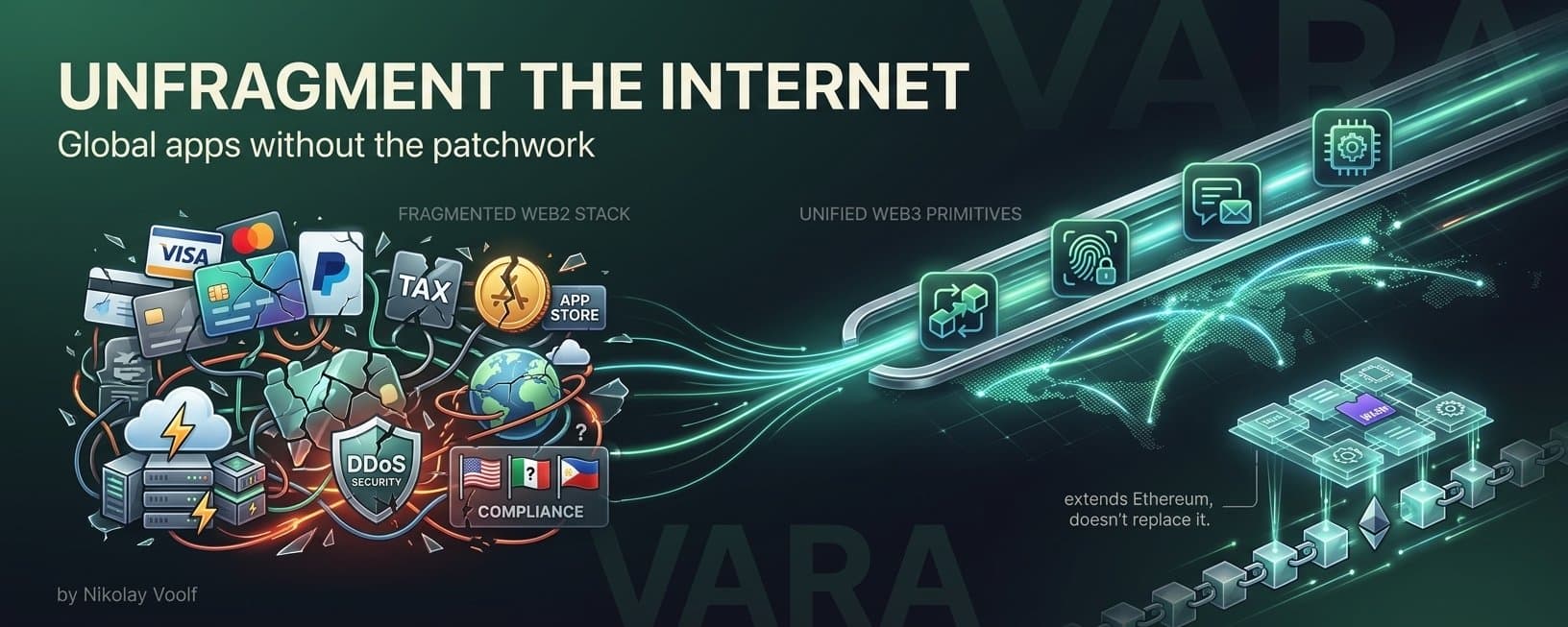
As a developer shipping a new global web app, you expect to focus on building features and great user experiences. Instead, weeks or months vanish into complex payment integrations, platform taxes, DDoS protection setup, unpredictable cloud bills, data residency, questionable latency in emergent markets, moderation burden (the list continues). You set out to reach the whole world with your ideas and services, but end up wrestling with regional regulations, platform policies, and third-party providers — only to repeat the entire process for every new market or platform. Relatable?
Traditional global landscape now
Payments
Let’s dive deeper into the first and most painful problem: payments. On paper, it sounds simple — a customer anywhere in the world happily pays you $1 for your service. In reality, enabling direct payments for a global application quickly turns into a fragmented, expensive, and high-maintenance nightmare.
You quickly realize that no single payment provider works well worldwide. Stripe and PayPal might handle the US and Europe decently, but users in India expect UPI, Brazilians want Pix, people across Southeast Asia prefer local e-wallets, and Chinese users almost exclusively stay within WeChat Pay or Alipay. Supporting these methods means integrating and maintaining multiple gateways, each with its own APIs, SDKs, currencies, and settlement rules.
Even worse, the costs add up fast. You’re often looking at 3–6%+ in total fees after international cards, currency conversion, and processing charges. Settlements take 2–7 days (sometimes longer), creating constant cash flow pressure. International transactions also come with higher fraud rates and expensive chargebacks — typically $15–25 each. And every new market brings additional VAT/GST obligations, data residency rules, and often the need for local legal entities. What should be a simple “Pay Now” button becomes a complex, fragile, never-ending subsystem that eats engineering time, shrinks your margins, and still leaves you vulnerable to sudden policy changes or account holds.
All of this just so a willing customer can pay you $1 for a purely digital service that requires no physical goods whatsoever.
Platform taxes
This pain only deepens once you factor in platform locks and their associated taxes. If you distribute through the Apple App Store or Google Play, you’re immediately hit with an extra 15–30% platform fee on top of your already high payment processing costs — effectively stacking taxes on the same transaction. You must route subscriptions and purchases through their in-app systems, which adds yet another layer of SDKs, compliance rules, and review cycles that can delay launches or force painful code changes. One policy update can instantly change your economics or block features, while getting rejected or throttled in key markets leaves you with few alternatives. What started as a simple global payment now becomes fully entangled in closed platforms that take a massive cut, dictate the rules, and limit your direct relationship with customers.
All of this is just about two parties exchanging 1$.
DDoS and global latency issues
We haven’t even touched the modern engineering challenges yet — those were just the financial headaches. After all, humans have been exchanging money for thousands of years, so you’d think the newer field of software engineering would be cleaner by now. Right?
In reality, running a truly global application brings its own set of persistent challenges. Even with CDNs and major cloud platforms, users in emerging markets often face noticeable latency (300–800ms+), leading to higher bounce rates and reduced engagement. DDoS attacks and traffic spikes remain an ongoing concern, requiring dedicated protection services, careful routing configurations, and regular maintenance. Much of this complexity stems from the fact that the payment layer is largely detached from your core application logic — forcing you to manage separate infrastructure, regional edge locations, and security layers just to deliver a consistent, low-latency experience worldwide. What should feel like a unified global service often ends up as several distributed systems that need constant attention.
Data residency and regional regulations
When you already thought that engineering part is easy, take a look on local regulations about data, entire universe of privacy laws: GDPR in Europe, PIPL in China, DPDP in India, LGPD in Brazil. Each demanding that user data, including the sensitive financial details tied to every transaction, must live, be processed, and be deletable inside specific borders. Your once-simple user database fractures into geo-fenced silos, consent engines, and automated “right to be forgotten” pipelines that can wipe a customer’s entire history overnight. This complete detachment from your application logic and user experience turns a clean global product into a compliance labyrinth: duplicated infrastructure, slower cross-border performance, endless legal reviews, and the constant threat of multimillion-dollar fines or outright market shutdowns. What should have been one unified experience is now a patchwork of regional compromises just to stay legal.
The list goes on
Beyond the main challenges, smaller but constant problems remain: managing fragile third-party APIs for authentication, notifications, and analytics; handling identity verification and bot prevention; fluctuating cloud costs; and the added complexity of multi-currency banking and basic abuse protection. Together, they create ongoing operational drag that keeps pulling focus away from building and improving the core product.
Of course, you can choose to ignore many of these issues, but doing so typically limits you to one or two major markets and exposes you to growing regulatory risks. Many go this path. But isn't it breaking the idea of Internet and lowering your exposure to customers?
The Illusion of Third-Party Solutions
A smart reader might notice that all the problems described above appear to be solved by various third-party providers. Payments can be handled by Stripe, Cloudflare manages DDoS protection and global delivery, AWS powers the infrastructure, and numerous KYC and compliance tools are readily available.
However, this approach has several important limitations. While each service addresses a specific issue, relying on a patchwork of third-party providers leads to cumulative costs that reduce margins, creates vendor lock-in, and increases operational complexity. You also inherit reliability risks, integration overhead, and limited customization, while remaining fully responsible for compliance and customer experience. Many of these solutions are also region-specific. A payment provider that works well in the US and Europe often requires completely different gateways, contracts, and integrations for markets like India (UPI), Brazil (Pix), or Southeast Asia. The same pattern applies to data residency rules, local KYC providers, and cloud configurations, meaning the setup, legal work, and maintenance must be repeated for every new market.
Additionally, many of these third-party companies actively lobby for stricter regulations that raise the barrier to entry, making it increasingly difficult to operate globally without depending on their platforms.
The Web3 way
Rather than continuously layering third-party solutions on top of the existing web2 infrastructure, a sensible Web3 platform removes the need to engage with these problems altogether. Permissionless payments, value transfer, and messaging are implemented as fundamental primitives directly in the application and protocol layer. Once you unhook from the need to integrate payments in your application, all other problems seem to collapse as well.
The promise of Web3 isn't just "crypto payments." It's a fundamentally different architecture: one where value, identity, data, and computation can be global, permissionless, and user-owned by default. Modern Web3 tools in 2026 make it possible to build rich, interactive web applications that sidestep many of the structural problems of the traditional stack.
Instead of integrating dozens of regional gateways (Stripe + UPI + Pix + Alipay + etc.), you deploy a smart contract once and accept stablecoins or native tokens anywhere with an internet connection. Transactions settle in seconds, not days. Fees are often under 0.1–1% (or near-zero on high-throughput modern chains). No chargebacks, no intermediary holds, and no need for local legal entities in every market.
In regards to data ownership and such, it should not be your problem. When we talk about unstoppable applications, it's not just about censorship. You literally can't stop anybody from interacting with them. Thus you can't be responsible.
DDoS protection is inherent to the architecture. Because application logic and state live on a decentralized network of nodes rather than centralized infrastructure, there is no single point of failure that can be effectively targeted. Well-utilized Web3 systems are designed such that the network remains operational even under significant pressure — individual RPC endpoints or gateways may be affected, but the underlying protocol and on-chain applications stay accessible through alternative routes and nodes.
In heavily regulated regions, Web3 networks can — and in my view, should — provide alternative secure routing mechanisms. By relying on decentralized node discovery, multi-path connectivity, and protocol-level encryption, these networks enable applications to route around restrictive firewalls, ISP-level filtering, or regional internet controls. This architectural resilience helps prevent the fragmentation of the global internet into isolated silos while maintaining consistent access to the application layer.
All of this is not theoretical. It is the result of over a decade of production systems built on Web3 infrastructure — if you look beyond the noise of memecoins and other speculative activity.
Liquidity and real-world exposure
This noble way is not without problems, obviously. Many modern Web3 chains and Layer 2s deliver strong technical performance but suffer from fragmented liquidity and limited native exposure to real-world assets and established capital. Ethereum mainnet continues to hold the deepest liquidity pools and broadest economic activity. Without seamless access to this liquidity, decentralized applications struggle to reach a truly global and diverse customer base. Prioritizing tight integration with Ethereum’s liquidity is therefore essential to prevent fragmentation and unlock real economic adoption. Otherwise, the substantial opportunity will forever be theoretical. Technically impressive but economically underutilized.
Addressing this challenge is the most important task in Web3 today. Not the pursuit of higher TPS, nor the generation of artificial intra-chain activity such as memecoins and NFTs, but enabling real interaction with global assets in one unified, interoperable ecosystem.
This is something I see people working on Ethereum and with Ethereum understand. I myself worked on Ethereum back when it was just going live. Then I spent a lot of time working on Polkadot, bringing WASM to the web3 where it now sits as a dominant way of developing and hosting applications. Now I and my team build and develop already live Vara.ETHwhere all of my experience and vision with regards to above problems finally crystalized into a clear, coherent and elegant application platform for Ethereum. If you, like me, can't be silent about the state of modern Internet, or just want fun engineering challenges, or anything related really – feel free to reach me on n@gear-tech.io, @NikolayVolf on X.